
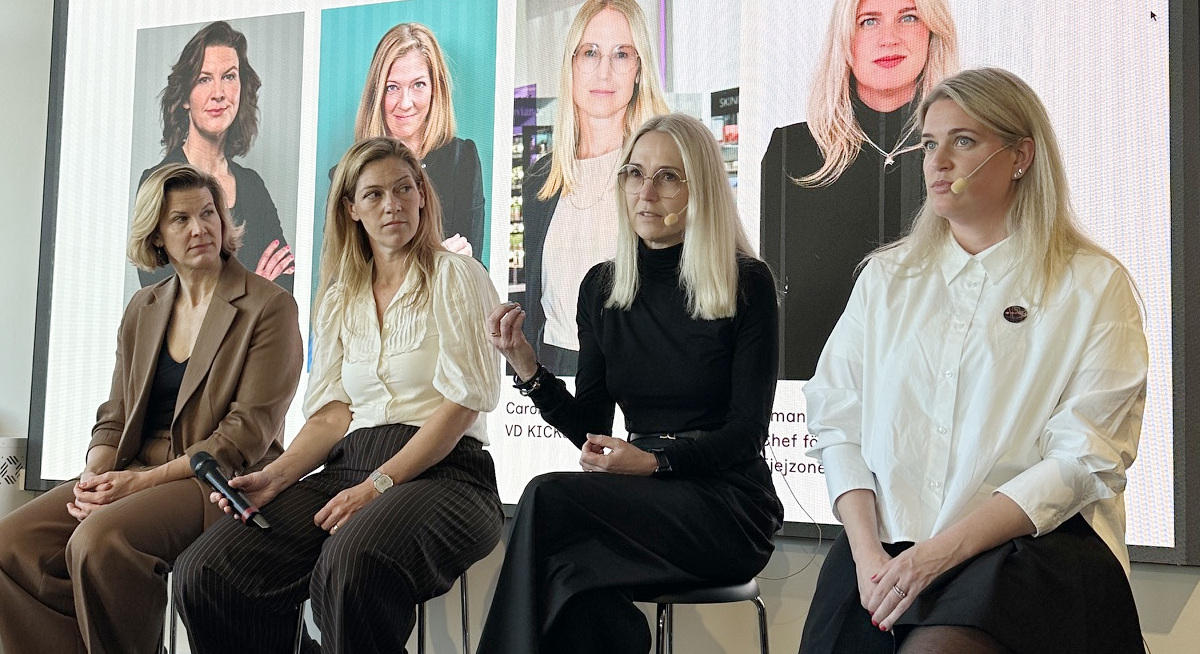
Swedish ministers, beauty business leaders, scientists, and NGOs respond to the sometimes shocking results from a new report unveiling a sharp deterioration in mental health among young girls and boys.
More than half of Swedish girls aged 16–31 describe the negative pressure related to beauty and lifestyle ideals as high. Among boys, pressure related to lifestyle dominates: 31 per cent describe it as high.
Twenty per cent of girls aged 16–21 who experience pressure say it leads to eating disorder–related behaviours. One in ten young people in the same age group report that the pressure has led to self-harm or thoughts of wanting to take their own life.
Seventy-two per cent of girls and 52 per cent of boys associate the negative pressure with the content they see in their social media feeds. About half of young people feel they cannot control the content they see in their social media feeds. At the same time, nearly seven in ten girls and four in ten boys say they use social media as a distraction from feelings such as anxiety, stress, and loneliness.
This year’s edition of The Hyperideal Report by Swedish NGO Tjejzonen (The Girls Zone) and leading beauty retailer Kicks includes disturbing statistics that require immediate and powerful calls to action.
– It’s incredibly moving to take part in this, says Nina Larsson, Minister for Gender Equality. This is an extremely important report. For many, many years, there have been numerous brain researchers and experts who have pointed to the risks and consequences of this completely naïve view of social media and digital tools. Now, we are in a moment of awakening where we simply cannot continue turning a blind eye to this. We have to act.
– We are now proposing what can be referred to as emergency measures, such as age limits for social media. Of course, if we had regulated the digital market with established frameworks and had a different level of awareness earlier, things might have looked different today. But when so many young girls are being affected so severely, with enormous consequences for their freedom—the freedom to shape their own lives, do what they enjoy, and feel well—we must act, and in several different ways.
The Swedish government, Larsson continues, has not done enough. Yet. Soon, the investigation into age limits for social media will be released, proposing exactly that, in line with other countries. However, where the country is lagging behind is somewhere else.
– It’s in the regulation of the platforms and to hold them accountable. We would never accept physical stores or other businesses behaving however they want. We have consumer protection laws. We’ve regulated other markets extensively for a very long time. But here, we’ve ended up in a very distorted situation with strong opposing forces.
– On the one hand, there are the commercial interests. We have a completely centralised internet landscape dominated by a few giant tech companies making enormous profits from the dependency they create among children and young people. These are powerful forces that often invoke concepts like freedom of speech and other important democratic values, while at the same time distracting from the real issue.
– This is a freedom issue for young girls and boys — the freedom to shape their own lives. And they are not free when they are constantly subjected to these pressures, hyperideals, and extreme appearance-obsessed culture, often tied to sexualised content, threats, or other harmful influences.
– We need to act on multiple levels. An age limit is an emergency solution that, unfortunately, has become necessary. We need to implement it. But above all, we must act together within the EU. We already have a solid foundation in the Digital Services Act (DSA), and the Commission has begun pursuing legal actions and cases. That’s very positive. But we are still behind, lagging.
The report also highlights the very different types of content girls and boys are exposed to. Boys are exposed to much more degrading content about religions, genders, and identities. Thirty per cent of boys aged 16–21 encounter this every day, 20% of them several times a day.
– That’s also incredibly alarming. You’re shocked when you read it. This is something that many of us might have intuitively felt. In conversations at upper secondary schools, these issues often come up. But now it’s presented in black and white, and it’s something we need to study much more carefully, Larsson states. She continues:
– The values spread through social media content shape the values people build their lives around. If you are immersed in this for ten hours a day—or however many hours many young people spend on social media—these values influence your behaviour, your well-being, your interactions with others, and ultimately the democratic values and freedoms our society is built upon.
– That is serious. Our democracy has been built over hundreds of years, and its future cannot depend on us maintaining a completely naïve view of the commercial interests and algorithms of global tech giants. We need to understand that this affects our values. The fact that so many boys are flooded with degrading, extremist, and anti-democratic values is deeply concerning.
The report highlights that among factors influencing ideals and fueling pressure among young people, the beauty and fashion industry ranks highly. For beauty retailer Kicks, this means a very clear responsibility to influence what people actually see.
– That’s what we as industry players can do — actively counteracting these ideals before they escalate into hyperideals, says Carola Lundell, CEO. There are also very concrete actions that anyone operating on these platforms can take. For example, considering whether the content they create is inclusive and diverse, reflecting real society rather than hyperideals. That’s why we developed an image policy several years ago, with the very explicit aim of counteracting objectification — something extremely common in the beauty industry, as well as in fashion. We later expanded that work by stopping retouching in our own channels and materials. We also introduced restrictions and clear policies for how we work with influencers, given how active they are on these platforms.
– Everyone needs to take responsibility for this. It’s not enough for one or even several companies to act — and we are certainly not alone. There are more companies working actively on this issue. But everyone must engage with it, because this is the responsibility we have, and it’s something we can influence here and now. This is not an emergency measure. Regardless of where we land on age limits and similar regulations, this is work we need to continue in order to address the ideals themselves and the feeling that there is only one ‘right’ way to look.
There are currently no industry-wide initiatives working on the topic, which is something Kicks is calling for.
– That’s one of the five measures highlighted in this report: it’s time for industry-wide initiatives, both within the beauty industry and especially within fashion, which we see as the two industries contributing most negatively to this pressure.
– Based on the work we’ve done so far, we wish we could say we’ve seen a broader shift, but based on the reports we’re seeing, we haven’t. What we haven’t seen, however, is any reduction in engagement. Using unretouched material is not less effective. So what exactly are people afraid of? Just do it. It’s not creating any negative effects commercially — quite the opposite. We receive a great deal of positive feedback, including from the influencer community itself, with many saying, ‘Finally, thank you for setting these kinds of standards for us.’ We wish we could see more companies working with this when they hear that it doesn’t negatively affect commercial performance. So that everyone dares to do it.

Sissela Nutley, a doctor of cognitive neuroscience and a researcher at Karolinska Institute, has written an expert commentary in the report. National and international research, she explains, shows very clearly how the brain is affected by constantly existing in this stream of intense emotions.
– When we spend this many hours each day consuming a specific type of information, divided along gender lines, it is obvious that we are being reshaped by it. We internalise it. Young people often don’t even realise that what they’re experiencing is unusual. To them, this feels completely normal; they struggle to articulate that they are being exposed to something specific or subjected to a particular pressure. This is simply their everyday reality.
– When you talk to young people, they say, ‘I’m just doing what everyone else is doing.’ They don’t realise they’re in a filter bubble, being constantly served material that shapes their thoughts and feelings about themselves for six, seven, or eight hours a day. In many ways, it’s essentially brainwashing. And naturally, that has a tremendous impact.
– We also see that it affects the opportunities people pursue in life. Studies show that girls are less likely to try new sports because they worry about how they will look in the clothes. This limits people’s possibilities. So it is very serious and deeply concerning.
Nutley just released a report for the Swedish Agency for the Media on how social media content relates to eating disorders and self-harm.
– We systematically reviewed the international research literature on social media content and its impact on self-harm behaviours and eating disorder symptoms. Unfortunately, it’s very dark reading. When it comes to beauty ideals and that kind of content, these are among the strongest findings in the entire research field concerning the effects of digital media on mental health. I would say it is very well established, with strong evidence of causal relationships between what people see in their feeds—especially content related to beauty ideals, ‘fitspiration,‘ ‘clean eating,’ and similar themes—and increased eating disorder behaviours.
– The evidence regarding self-harm behaviours is somewhat less established simply because there is less research, though there are still around fifty strong studies on the subject. But when it comes to eating disorders, the causal connections, unfortunately, are very well supported by research.
– We also see that algorithms significantly amplify these effects. People who already have eating disorder symptoms are served up to 500% more eating disorder–triggering content than those without such symptoms. This is especially apparent on TikTok. The algorithms intensify these negative spirals enormously. Even when users try to distance themselves from that type of content or adjust their algorithms, they are still exposed to it against their will.
The report author Amanda Oxell’s biggest takeaway is that we can now clearly demonstrate that increased social media use is followed by a sharp deterioration in mental health.
– I really want everyone to understand the magnitude of it. This is also reflected in international health data. This isn’t simply a national development — it’s an international one, perhaps not entirely global, but certainly widespread across countries.
– The report’s influence, I experience, has grown year after year, becoming something that authorities refer back to when preparing proposals and investigations, and something businesses use to motivate changes in their business models.
– Now that we know this, we cannot step back. We have to engage in finding solutions moving forward. And everyone must work to prevent this debate from becoming polarised, where social media is painted as pure evil and something that should disappear entirely. We need to be capable of holding multiple thoughts at once and working together to find solutions that address the underlying problem, she concludes.