
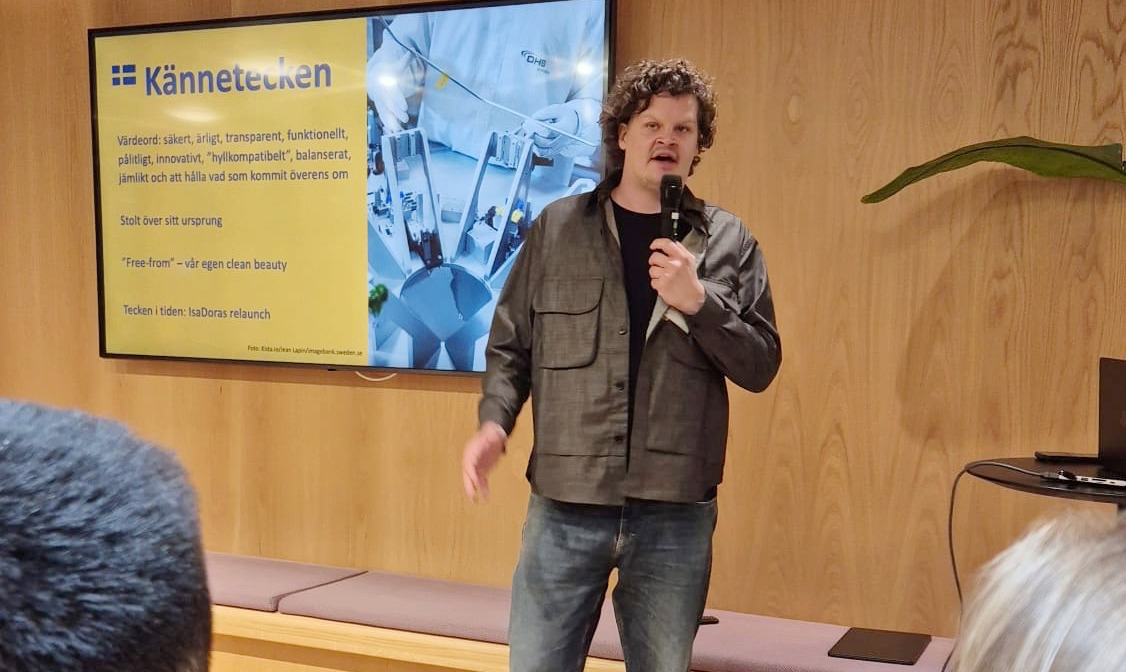
What’s unique about Swedish beauty? What are the innovations to watch? Yesterday, The Beauty of Innovation took the stage at two beauty industry organisations’ members meetings to share some of the takeaways from the Swedish Institute’s upcoming communication material for Swedish beauty.
The Swedish Institute is a state-owned organisation aiming to strengthen the image of Sweden for a global audience—so-called soft power—and create business value for Swedish companies. One of the tools to do so is to create “toolkits” about how Sweden stands out in certain industries. The Beauty of Innovation’s founder, Johan Magnusson, was selected to write the material on Swedish beauty, which is set to be handed out to Swedish embassies and government offices across the world. This communication material will also be published online, at sharingsweden.se, in August.
Here are some of the takeaways shared with the members in The Swedish Cosmetics, Toiletries and Detergents Association (KoHF) yesterday morning and Association of Swedish Beauty Brands (ASBB) (pictured above) in Stockholm yesterday afternoon.

The industry in numbers
18,000 Estimated number of people employed in the hair and beauty industry, including hairdressing services, wholesale and retail trade of perfume and cosmetics, as well as the manufacturing of perfumes and toiletry products.
15,000 Industry estimate of the number of hairdressers who are self-employed, together with other independent professionals.
Total: Approximately 40,000 people
The industry in statistics
19
Ranking among the world’s largest exporters of beauty products
10
Ranking among the largest beauty product exporters to the United States
2.5×
Higher export growth than South Korea (2019–2024), making Sweden one of the fastest-growing exporters on the list
10%
Self-reported CAGR (compound annual growth rate) among natural skincare brands operating in Sweden, until 2030
Major competitors
Traditionally: The United States, France, the United Kingdom, and the Nordic countries—most recently, especially Finland
Current situation: Significant growth in South Korea, creating business opportunities for Swedish companies
Futural: China? On equal terms? The fashion industry has faced significant competition from Chinese ultra-fast fashion. Will beauty see the same development? Will coming EU regulations be able to stop it? The mentioned equal terms are also about how Swedish companies often experience significant problems with bureaucracy when exporting to China, although last week’s news might improve the situation.
The success factors
Engineering traditions
Sweden is a country built by engineers. Their mindset is to deliver what’s agreed on. That same thing is the very essence of the beauty industry. Swedish beauty companies’ labelling is seldom about exaggerated claims but focuses on delivering what’s agreed on.
The dermatological heritage
The Swedish pharmacy monopoly was removed in 2009, but its legacy remains. Although the pharmacy companies’ quality controls are less strict now, it’s still a quality mark to go through it. Several of the leading beauty brands began their journey in Swedish pharmacies, laying the foundation for a stable, trustworthy, and reliable brand before expanding.
A strong, local, entrepreneur-driven ecosystem
Sweden is the home of H&M, IKEA, Spotify, and many more, founded by creative minds disrupting their fields. The societal safety net enables entrepreneurs to test one, two, maybe three business ideas, and the country’s smaller size means that thinking about export is a natural step to take.
Economy
75% of the leading retailer Kicks’ turnover comes from high-end products. The population is wealthy and can afford to try new products, brands, and trends.
End consumers
The savvy customers are famous, by some infamous, even by the world’s biggest beauty brands, to push brands to do more and do better. They therefore serve as the perfect test bed before expanding to a new retailer or a new country.
Characteristics
The Swedish Institute’s communication material almost completely avoids using the term “sustainable” to describe things. Everything that is being produced, also beauty, is, per se, not sustainable.
That said, some core values to define Swedish beauty are: safe, honest, transparent, functional, reliable, innovative, “shelf-compatible” (well-designed), balanced, equal, and trustworthy.
Also characteristic is how Swedish brands are proud of their origin. Several of them even use it in their brand name: “of Sweden” and such.
Several people who have been interviewed for the material push the “free-from” mark, for instance, silicones or parabens, as being typical for Sweden. This, however, can be problematic to use, not least after the implementation of coming EU regulations. Similarly, Sweden hasn’t jumped on the “clean beauty” wave flooding the world until legislation in Brussels forces brands to stop using such vague claims, greenwashing, and fearmongering in their communication. Instead, our own version of clean beauty is our clean water used in the local beauty production, with nature in mind.
A sign of the times is IsaDora’s relaunch. When the leading Swedish beauty brand was founded, in 1983, the founders wanted to create everything that Sweden wasn’t. Instead, they looked at the glamour in France or Italy, aiming to create a local equivalent. When the brand relaunched, in 2023, the current executives chose “True Beauty from Sweden” as brand identity, aiming to tick all the boxes that Sweden is. The needle has turned.
Sustainability and innovation
In Sweden, sustainability is a hygiene factor. Although not as important as five years ago, end consumers still demand brands to do more. This, however, comes with certain reservations. Swedes shop the second most beauty products in the EU, which requires huge resources. The bathroom cabinets are full of semi-finished products, while the weekly TikTok trends push customers to try the new hype. After fast fashion, shall we talk about fast beauty?
Still, many brands aim to be at the forefront, pushing the industry forward. One executive shared in the Swedish Institute material how her company included a certain request regarding a very advanced and innovative packaging feature in every quotation to the factory. Not because they required their producer to deliver on it, but to stretch what was possible. A couple of years later, the manufacturer replied that this had sparked an internal R&D process and that they were now ready to offer the solution to them.
Next area of development: cellulose? Earlier this year, The Beauty of Innovation visited leading beauty packaging fair PCD in Paris. All across the fair, producers communicated about bioplastic and cellulose packaging solutions. Many of them also swaggered that they were “Sulapac compatible.” The Finnish packaging innovation has set a new standard for biobased solutions, and being the second most forested country in Europe, Sweden has a golden opportunity to jump on this new wave. This is already happening with startups working to modify cellulose and include it in biodegradable cosmetic formulations. But also in one of three innovative industry players potentially reshaping the beauty industry as we know it.
Blue Ocean Closures develops and manufactures fibre-based closures and components using proprietary press forming technology. Based in Karlstad, the company partners with leading global brands and converters to replace plastics with renewable, recyclable materials. The company is the first in the world to launch commercial fibre screw caps, proving the viability of large-scale, high-quality fibre forming for industrial packaging applications. Backed by industry leaders such as ALPLA, Magnera, Nissha, Rottneros and Elopak, Blue Ocean Closures is exploring new packaging solutions and enabling brands to decrease their carbon footprint.
3D printing is redefining the future of manufacturing. In 2020 alone, around two million 3D printers were sold, capable of working with materials such as plastics, metals, and ceramics – yet glass remained a significant limitation. At the same time, demand for complex glass components continues to grow across industries, including medical technology, optics, aerospace, solid-state batteries, art, and jewellery. Swedish innovation company Nobula’s glass 3D printer addresses this gap by enabling the production of intricate glass structures. Powered by Direct Glass Laser Deposition (DGLD) technology, it makes printing with glass as straightforward and accessible as printing with plastic.
Located in Motala, Site Zero is the world’s largest and most advanced plastic sorting facility, capable of sorting 12 different types of plastic packaging into pure fractions using AI and 60 NIR sensors. Big enough to receive all plastic packaging waste generated from Swedish households, it can process 200,000 tonnes annually, sort up to 95% of incoming plastic to minimise incineration, and is designed to double the amount of plastic packaging materials being recycled in Sweden.
Challenges
The communication material also addresses some of the challenges that the Swedish industry is facing.
- Fortune-hunters are a long-time issue, and there are few signs that they will go anywhere.
- Bureaucracy, for instance, when exporting just to another EU country, not to mention China.
- The most common description we hear from people to describe the beauty market is “saturated.” No country is immune to that.
- The same goes for macroeconomic conditions and the current cost-of-living crisis.
- Last but not least, uncertainty surrounding pending EU legislation creates uncertainty about which future lies ahead.
Summary
What stands out in a global context is a strong focus on functionality, high trust in dermatological products sold in pharmacies, talented entrepreneurs, thoughtful packaging design, and digitally savvy consumers who are curious about new products.