
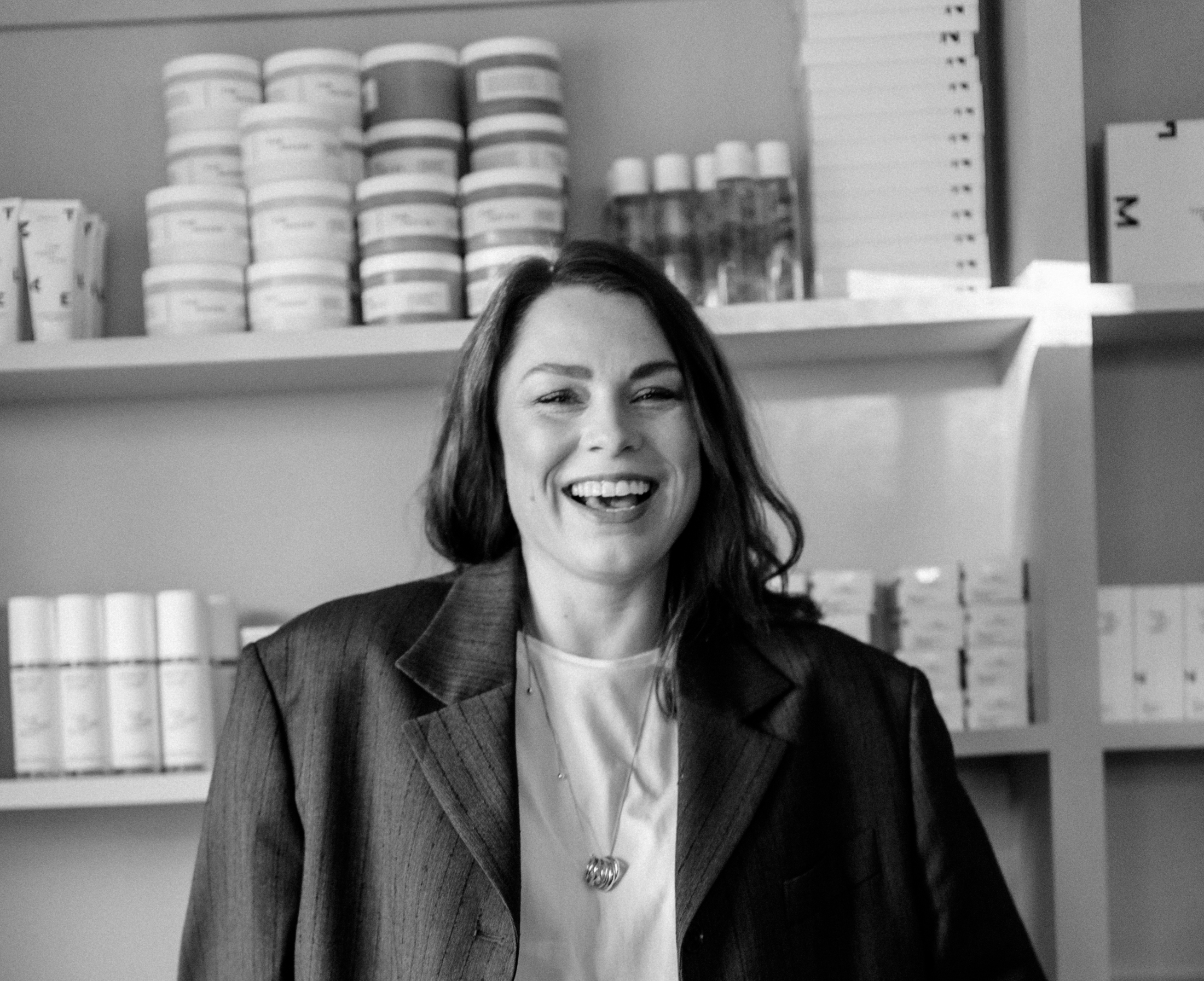
We speak to co-founder Josefin Landgård about the recent shifts marking a new era for the brand, the entourage effect and why it matters, and the beauty industry’s fundamental problem with how it talks to women.
The emerging beauty brand just entered the biomimetic space with the launch of The Marrow Mask. Yes, bone marrow.
– We have always been obsessed with biomimetics as we explore what the skin actually needs to function at its best, co-founder Josefin Landgård explains. The beauty industry tends to be obsessed with finding the next miracle ingredient. But skin is a complex organ, and I don’t believe the future of skincare lies in isolating one molecule and putting it at the highest possible percentage.
– We’re interested in how different ingredients work together and how we can use modern science to explore biological materials. It’s why we always use a combination of actives and formulate well designed products that achieve results.
– The Marrow Mask features multiple biomimetic ingredients including bone marrow. Bone marrow is naturally rich in lipids and has been used for its healing properties for centuries.

You made yourself a name as a Scandinavian CBD beauty pioneer. We barely hear anything about CBD anymore.
– No, I think that’s quite revealing about how the beauty industry works, Landgård agrees. An ingredient becomes the next big thing, suddenly everyone has a product containing it, and a few years later the conversation moves on.
– But ingredients don’t suddenly stop being interesting because people stop talking about them. CBD was our starting point and set our direction. Cannabis has incredible anti-inflammatory properties and amazing lipids. It remains an ingredient we believe in, and the before and after pictures of our customers over the past five years speak for themselves. We are just so hungry and curious for the next frontier and what else we can do as we keep creating and moving forward.
– We’ve never wanted to build a brand around one ingredient. We’ve wanted to build a brand around a different approach to skincare.
– That’s also why we invested in our own laboratory. I want us to have the freedom to investigate ingredients because we find them genuinely interesting, not because they’re trending on social media.
– Sometimes that means working with something familiar, like niacinamide. Sometimes it means exploring something as unexpected as bone marrow.

You also talk about the ‘entourage effect.’
– Yes, that ingredients often work better together than in isolation. The concept comes from cannabinoid research, where whole-plant extracts appear to behave differently from isolated molecules. We believe the same logic applies to many compounds, and it shapes how we formulate.
– The beauty industry loves a hero ingredient. One molecule on the packaging, a percentage, an entire story built around it. It’s easy to communicate, but skin biology is rarely that simple. We look at the whole formulation. How do lipids, actives, and supporting ingredients work together, and how do we get results by strengthening it rather than constantly pushing it harder?
How will the conversation around biomimetic skincare evolve?
– I hope we’ll be talking less about individual ingredients and more about what skincare actually does for the long-term health of our skin. There’s a tendency in beauty to confuse innovation with novelty. A new molecule, a new technology, a new claim. But I don’t think something is innovative simply because nobody has used it before.
– For me, innovation is about challenging assumptions. With The Marrow Mask, part of the inspiration actually came from looking backwards. I live on land with a history dating back to the Viking Age, and I became fascinated by old Nordic traditions of using every part of an animal rather than letting valuable resources go to waste.
– That curiosity eventually led us to explore Swedish bone marrow through modern formulation science. I think we’ll see more of that intersection between traditional knowledge, biotechnology, and responsible sourcing. But I also hope the industry becomes more demanding about evidence. If we’re going to talk about skin longevity and biological function, we need to be able to explain what our products actually do.
– The future shouldn’t just be about making more sophisticated claims. It should be about making better products, Landgård states.

Josefin Landgård’s extra industry insights
– I think the beauty industry has a fundamental problem with how it talks to women. For decades, we’ve built an enormous industry around the idea that ageing is something to fight, that wrinkles are failures and that there’s always something about your face that needs correcting. I find that quite outdated. And frankly, not particularly imaginative from a business perspective either.
– When I co-founded KRY (a leading European digital and physical healthcare provider, known as Livi in the UK and France, Ed’s note), we challenged the idea that healthcare had to work the way it always had. I think beauty is ready for a similar shift.
– With skin being our largest organ, we’ve still spent decades talking about it almost exclusively in terms of appearance. What if we started treating skin health as the foundation of beauty rather than an afterthought? That changes everything from how we formulate products to how we communicate with consumers.
– I also think brands underestimate how much women have changed. They’re informed, curious, and increasingly sceptical of exaggerated promises. They don’t necessarily want another product telling them how to look ten years younger. They want to understand what they’re putting on their skin and why.
– My advice to the industry would be to stop looking for new ways to make women feel inadequate and start finding new ways to make skincare genuinely better.
– There’s an enormous business opportunity in that. And I think the brands that understand it will be the ones that matter in the next decade.