
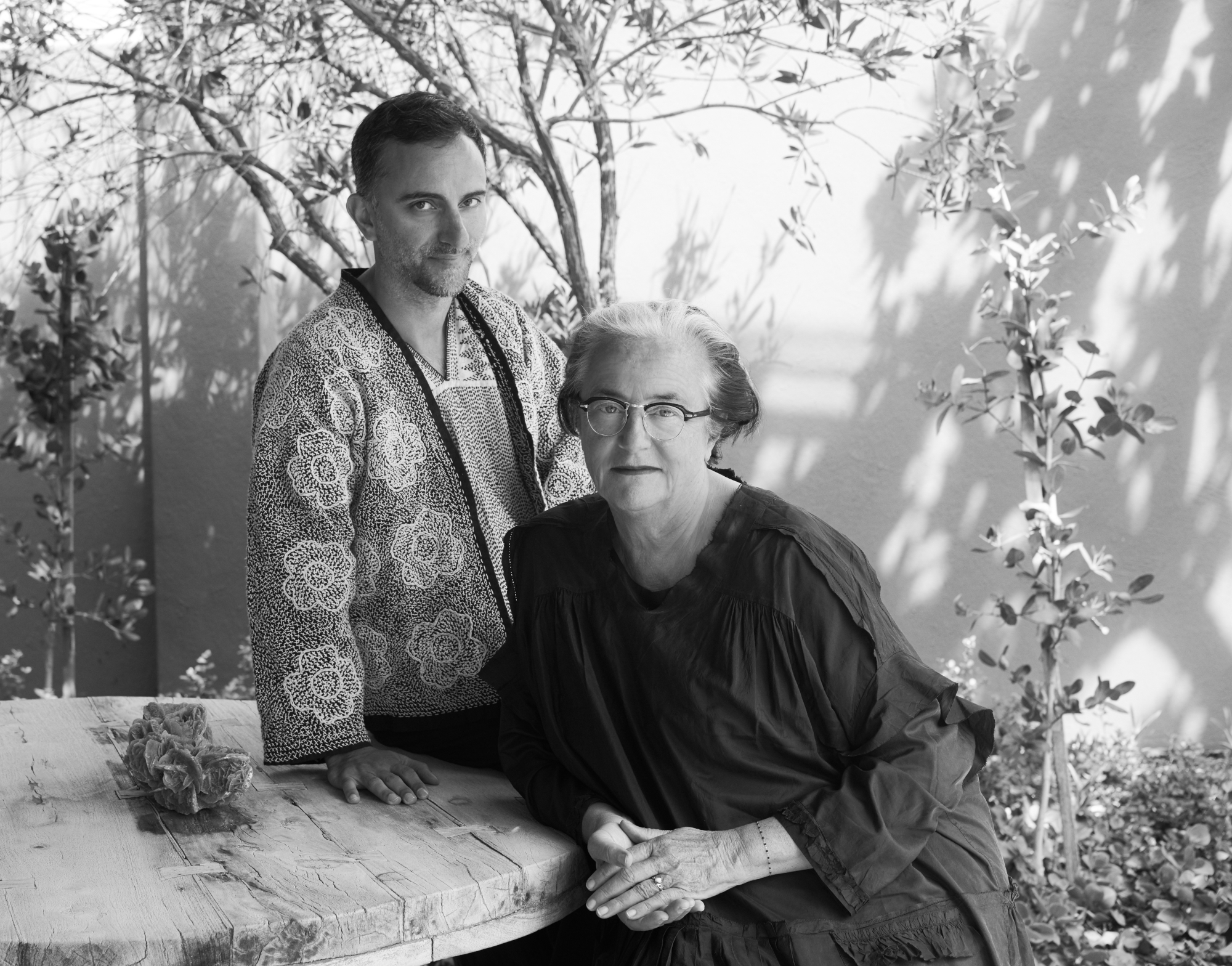
Is the next generation of wellbeing also about what we put on our body? Leading trend forecasting duo Li Edelkoort and Philip Fimmano share the rise of natural materials and the dream beauty client, including the opportunity to make an icon even more iconic.
We meet the duo at a hotel in Stockholm for the design exhibition INNER CHILD: Playing with Design at Artipelag, highlighting playful design and natural materials.
– Wool, especially, is a big thing that we are fighting for, Edelkoort shares.
What can you say about it? I’m also curious about it and its unleashed potential.
– It’s part of a bigger interest, I think, in fibre, understanding the origin of materials and the connection between fibres and the land, Fimmano shares.
– It’s a gift, Edelkoort states. Wool is a gift that keeps on giving until it dies. It’s a beautiful resource if it’s well done. And in fact, we belong to each other because we need their fibre’s warmth, and they exist because of us. It’s like a giving interconnectedness. Wool is an underrated quality because it’s fire- and rain-resistant, so it’s very protective, and it’s not very well-known that all these things are there. You could do outerwear in wool, and it would be just as good as polyester or better, obviously much better for the planet. I think that there’s only 2% of fibre in the world which is now wool. It’s disconcerting. The fight is necessary.
– It’s overlooked a lot, Fimmano continues. In Europe, it’s seen as a byproduct of the meat industry. Sometimes it’s even given away for free because it costs more to discard it than not. Instead, you can use it for many, many purposes. It’s undervalued.
– You can even turn it into building blocks to make inner buildings and bricks, or use lanolin, of course, which is also an industry, says Edelkoort. It’s almost totally unstudied. Now there are many young people, including farmers, designers, and activists, in different countries, speaking the same language. We are getting bombarded with wool people from all over the world recognising what we do. Next year, we will do a second edition of World Wool Forum about it.
You’ve become like a catalyst.
– Yes. Philip is Mr Wool! Also, since he’s from Australia, says Edelkoort.
– Well… I’ve met a lot of people about this, that I can say! says Fimmano.

Lanolin is obviously also highly valued in the beauty industry, although the demand is shrinking given the rise of vegan beauty.
– Yes. Beauty has now expanded to being not just the obvious – what you put on your face and in your hair and now, what you ingest in your body, says Fimmano. Beauty is also what you surround yourself with or what you wear. They’ve done scientific studies to show that the benefits of wool are better for your body and your overall health and wellbeing. So, from a wellbeing perspective, they even have scientific data saying that it’s better to wear wool than to wear synthetics. This also includes activewear and lingerie, or even, of course, bedding.
– There is a lot more interest in natural fibres and, in particular, different kinds of wool, which is all kinds of animal hair, not just from sheep. It’s an expanding area of study even for academics and scientists. And of course, the industry just needs to put it all together, also with the support of governments, because it needs to be subsidised more in order to make it more respected and higher in value.
In Sweden, it used to be the case that the wool was burned and brought into landfill. But then, NGOs and companies came together to create a new Swedish value chain to make use of it.
– Yes. And don’t forget, there are over 100 different kinds of sheep, so there are so many different qualities. Each one can be used for different things. They’re not all the same.
Although you’ve always focused mainly on design, how have you worked with beauty?
– We have worked with beauty, and particularly fragrance, Edelkoort explains. We worked for 20 years with Estée Lauder and 15 years with Calvin Klein Fragrance. But that all stopped after the big boom at the beginning of the century. The companies decided to rely on their own creative forces, which are marketing forces. This is why we see the decline in creativity in that world.
And how do you follow that?
– It’s very interesting in the new ingredients they find. Let’s say that the science of beauty is very creative. But the vision of beauty is not, I think.
Has it been ruined by AI? Or lower budgets?
– By human AI, Edelkoort explains.
– Non-intelligence, Fimmano agrees.
– HI. Human intelligence. People have already worked with algorithms for a long time now, and we have seen the disaster it causes, not least with all the overproduction. How is it possible? If you’re able to calculate with algorithms what products to make, why do you then still make too much? It’s largely too much. Billions of garments. How come? This is where you know that many things are not working, Edelkoort states.
And after fast fashion, we now hear a rising topic: fast beauty.
– Oh, yes.
But the bigger discussion should obviously be about how we consume, right?
– Yes. If Shein is buying Everlane, there is maybe a message there that even they need to have a better brand with better products, better textiles, and better values. They know that their values will one day be so disgusting to people and that they might fail. We see this in Zara very strongly, which is aiming at a higher price point, or mentality point, even. And we see it with the success of COS, of course. Such a great success. COS is like the miniature Olsen Twins brand. All in all, there’s a shift here, and I see that consumers do enjoy this new level of quality they can find for their next shirt or a pair of pants.
Since you stopped working with those beauty brands, how have you followed the industry? And what would you like to contribute or see more of if you were to return to it?
– I’m not sure if I would like to work in beauty right now, says Edelkoort. I’m not an eyelash or nail person. No, I would love to work with some brands, of course, which have the human side in the centre of…
– And longevity, Fimmano adds. Li’s last wish to work in beauty is to collaborate with this blue cream…
– Nivea. That’s my dream, to work with Nivea, Edelkoort shares.
– It’s an evergreen brand. A classic product. Democratic, says Fimmano.
Would you like to redefine the product?
– I would like to work with them on how to make it even more of an icon, says Edelkoort.
That’s also part of a bigger picture, not only for beauty, of course, but the constant newness and that you perhaps are not putting enough effort into your hero face cream or whatever it is.
– Yes. Apart from the cancer of marketing that has ruined all these brands, the second problem is the need for constant innovation, Fimmano agrees. Li has a term which she calls unnovation, which is not having to launch a new product every year, but only launch something which is going to last for many years. You just tweak it a little bit each year, or you re-market it, but it’s still the same thing. It’s the idea of slowing down, of having less products, of streamlining the choice, of having better quality but fewer things. All of that is a form of sustainability. But it’s also a new luxury because to unnovate is actually more avant-garde than to be innovative at this point. Young people especially want to have honest, authentic products, and they can smell a marketing trick a mile away. The inauthenticity that a lot of these brands have could be helped greatly by not having to constantly launch a new thing.
And the rise of wellness can be connected to a slower living that you just mentioned, and a new way to approach our daily life?
– Yes. Focus, clarity, and purpose become the new wellness industries. It’s not just mental health; it’s also how you feel when you get out of bed. How do you talk to your neighbour? How do you interact with someone at the supermarket, if that’s your only connection with a human that day? People feel very alienated and lonely, so the isolation of technology is creating a new need in people to strive for connection in a new way. It’s not just tactility; it’s also mental; it’s social. How to flirt, how to dance. It’s very analogue. Everything is shifting towards analogue taking on a greater role. In our exhibition especially, but also in society.
The digital fatigue.
– Completely, Edelkoort agrees. And this is why reading is coming back. Libraries, bookstores… And cooking, gardening, and walking.
– Doing. Just doing. Being present. Playing card games, fishing. Many things.
You mentioned the marketing crisis. Can you evaluate where we are in marketing?
– Marketing used to be a profession which was akin to my profession of forecasting, Edelkoort remembers. It would take into account forecasting trends and mix those trends with the vision of their market and what the results were, where their consumers are going and so on. It would be a skill which would bring the brands forward with a degree of security based on the brand values, but taking risks as well to renew the brand so it would keep on being relevant. Now, that has become the profession of scared individuals, who are afraid of taking risks, change, and trying out new things. It has gradually stifled.
– It’s this algorithm you were talking about earlier (relating to the disaster they have created, especially when it comes to overproduction, Ed’s note) where they all want a formula for how to make money, says Fimmano. But things like perfume or art or textiles or fashion are all emotional industries, so you cannot just type in a formula. It needs to have an emotional impact. It needs to have resonance. That’s why these companies are all in trouble, because they’ve given too much importance and power to the marketers, and taken it all away from creatives. If they still have creatives. Some brands don’t even have creatives anymore. It’s a major epidemic crisis of creativity, even a form of corruption.
– They have the power, Edelkoort continues. There’s the CEO, and they are up here, and all other professions are lower. That is the danger: that suddenly marketing is deciding if this museum should have this or this show.
– Not culture, Fimmano adds.
– This is why life is becoming more lifeless, Edelkoort shares.
Finally, are trends as relevant as before?
– I think they might be even more relevant because there’s such chaos and confusion that somebody needs to puzzle out and figure out how things work. It’s not just forecasting; it’s also editing and curating and trying to make things clear. It’s like we’re in a restaurant with a menu card of 500 pages or something. So, it is more relevant today. It’s more important today, because you’re more lost.
– Maybe it’s also deeper now because it’s even the word trend maybe is not the right term because it’s more about anthropology and understanding and anticipating where we’re going, says Fimmano.
– But that’s always how we saw trends. So for us, it’s the same, says Edelkoort.
– For us, it is the same, Fimmano agrees.
Top picture: Thirza Schaap