
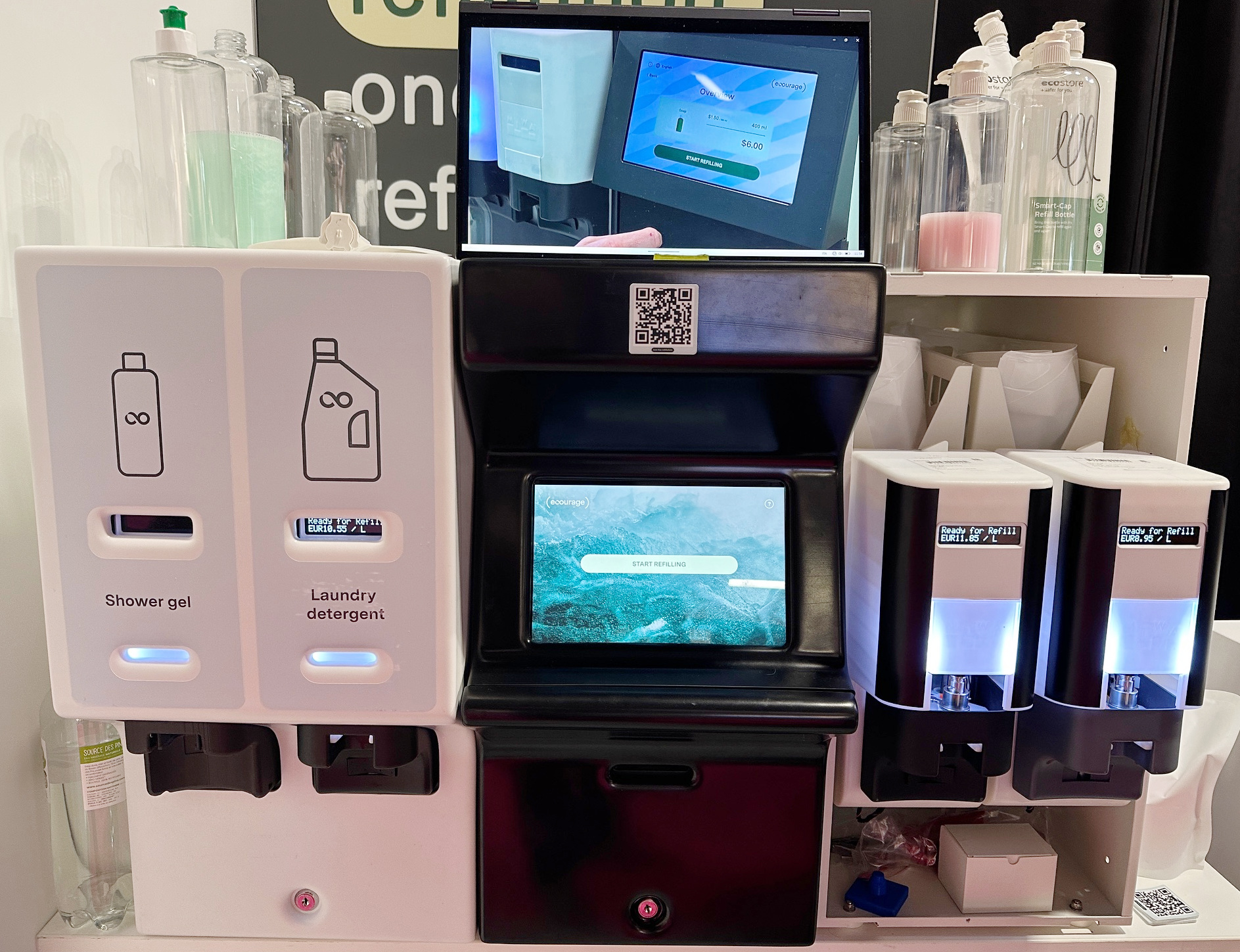
Introducing: “100 innovations that can transform beauty.” Data management and tech solutions enable this refill system to not only save resources but also enhance consumer loyalty. Mess-free, scalable, and a marketing tool to “promote the bond between customer, retailer, and brand owner.”
In this new series, we meet the beauty packaging innovators, ingredient entrepreneurs, and everyone in between already reshaping, or with the potential to reshape, the industry.
First out: Ecourage.
Reuse shifting from niche to strategic priority is a fact, Alessandro Porta, European Sales Manager, states.
– Consumer willingness exists, but convenience is the key factor. We need to play in fast consumer goods since the economics improve dramatically with higher rotation. Regulatory pressure in Europe is accelerating the PPWR timeline. The future will be designing ecosystems, not just packages.
What does it take to scale refill solutions? Ecourage started under its Norwegian parent company, Smartseal Closures. The founders previously pioneered closed-fill cap technology integrated with an earlier generation refill system. Recognising refill as the future of packaging, they created Ecourage to scale refill globally, not limit it to one-off pilot programs. Achieving that vision requires patented technology but also demands cost competitiveness, operational efficiency, and a system designed to drive mass consumer adoption.
– Refilling has been around for centuries. Before single-use packaging everything was filled in reusable jars and glass. Now, we believe the time to shift back to that process is the best solution to reduce packaging, reduce costs and, very importantly, to be used as a marketing tool to promote the bond between customer, retailer, and brand owner, says Alessandro Porta, European Sales Manager.
Returning customers is key.
– Yes, customer adoption is key to reduce plastic waste, and also a great reason for them to return to the supermarket or store. In doing so, it strengthens the relationship between retailer and customer, and between brand and customer, by turning a routine purchase into an ongoing interaction.
Tell us about the technology.
– At the core of our solution is a controlled, automated filling technology designed to make refill seamless and mess-free. Each component is enabled with smart NFC technology (Near Field Communication): a small wireless chip and antenna that stores data and enables seamless communication between our refill hardware and software platform. This technology gives us real-time insights into machine performance, environmental impact, such as the number of bottles saved, and creates a direct line of communication to the consumer.
– Both the bulk supply pouch and the dispensing unit are equipped with NFC, making the entire system fully traceable from end to end. Traceability is only part of the story, though. The real unlock is bulk distribution. By shifting from single-unit logistics to connected bulk supply, we significantly reduce packaging, transport, and handling costs across the supply chain. This not only lowers to the cost at the tap, but also enables true scalability.
– A key innovation lies on our data management platform, something manual refills systems simply lack. The NFC connectivity is cloud-based, creating a centralised data hub for brands and retailers across all their locations. The platform provides real-time insights into machine performance and inventory levels, eliminating out-of-stock situations and enabling operational efficiencies. Integrating loyalty programs or membership systems, brands, and retailers can reward sustainable behaviour, personalise offers and gamify the refill experience. What was once a messy, manual process becomes an automated, interactive experience that rewards customers while delivering measurable value to brands and retailers.
NFC has obviously been around for a while and when you explain it like this, it can be quite surprising that it’s not used more.
– The reason why it’s not used more is very simple: cost. When we have a single use plastic technology, it’s not worth it. But in a reuse system where packaging is used 10 or more times, the cost of NFC doesn’t get passed on to the customer.
What is it that is patented?
– Our solution is built as a fully integrated ecosystem comprised of four core elements: OmniTap, the dispensing unit; OmniCap and Connected Smart Fill are our closed- or connected-fill solutions with embedded NFC technology; OmniBib, the bulk supply system; and the SaaS-based digital management platform that connects it all.
– Several components of this ecosystem are patented, including the dispensing technology, the smart scaling, and the cap design.
You mentioned 10 times. Do you expect the bottles to last for 10 refills?
– No, more actually. Producers determine the limit based on the quality and safety measures needed for their products. However, the machine gives you infinite refills and with the right material choices, what is currently considered single-use packaging can evolve into long-term, high-value packaging. We’ve all seen plastic bottles that have been floating in the ocean for 30 years, so the material durability has never been the issue; the system design has.
– Some systems on the market rely on consumers washing the packaging at home. The issue is that domestic washing is not industrially optimized, and in many cases, it reduces overall sustainability benefits of reuse.
– In our long-term vision we see an opportunity to embed NFC technology directly into durable packaging. When a container reaches the end of its approved reuse cycle, it could be deposited near the machine, automatically recognized via NFC, and sorted accordingly. Instead of becoming unmanaged waste, it re-enters a controlled recovery and replacement flow.
– That is the next step. Instead of 10 reuse cycles, a container could potentially be used 20 or more times, significantly reducing the need for virgin plastic extraction and other raw materials used in disposable packaging.
You launched it a year ago, how is it going?
– It’s going well. Our first in-market business case is with a sustainable brand from New Zealand. They launched our technology in flagship stores in New Zealand and Japan and have since expanded, adding multiple machines across several locations with a prominent Japanese retail partner.
– Now the system is currently in its industrial rollout phase, a true greenfield opportunity. We are experiencing that it’s more difficult to be successful in a market where retailers have already tried the refill technology, and failed, rather than being in the greenfield situation where it’s something new. In Europe, refill is quickly moving from optional to inevitable given the regulatory requirements coming in the next few years.
How much does it cost?
– It’s a total system solution. The hardware represents a one-time investment, while data platform operates on a monthly subscription model. We also offer rental and leasing options for the hardware. We’ve taken great care to engineer the system for cost efficiency so our customers can achieve a strong ROI in a timely manner.

And you can also secure the return of investment and increase consumer loyalty.
– Yes. And we expect that refill will grow. Much of the momentum is driven by legislation, especially in Europe and the United States. Similar to PPWR, EPR in the US has a goal to reduce the consumption of packaging and to recycle what continues to exist, Porta shares. He continues:
– In Asia, it’s different. For example, in Japan waste management costs are very expensive. Even if you have a recyclable packaging made of glass or plastic, it doesn’t matter. The cost of collecting, sorting, melting, and grinding is very expensive. So reuse packaging quickly becomes the more appealing option.
– Everything comes back to that need for things to be cheaper. If it’s more expensive, it remains a niche. That’s not where we want to go. We want to go big. For the hardcore sustainability people that really care about the environment, they’re already doing the right work but in the end, that is not what will change the world. The world is millions of people that work every day, go home and want to eat and enjoy stuff—that’s who we want to appeal to!