
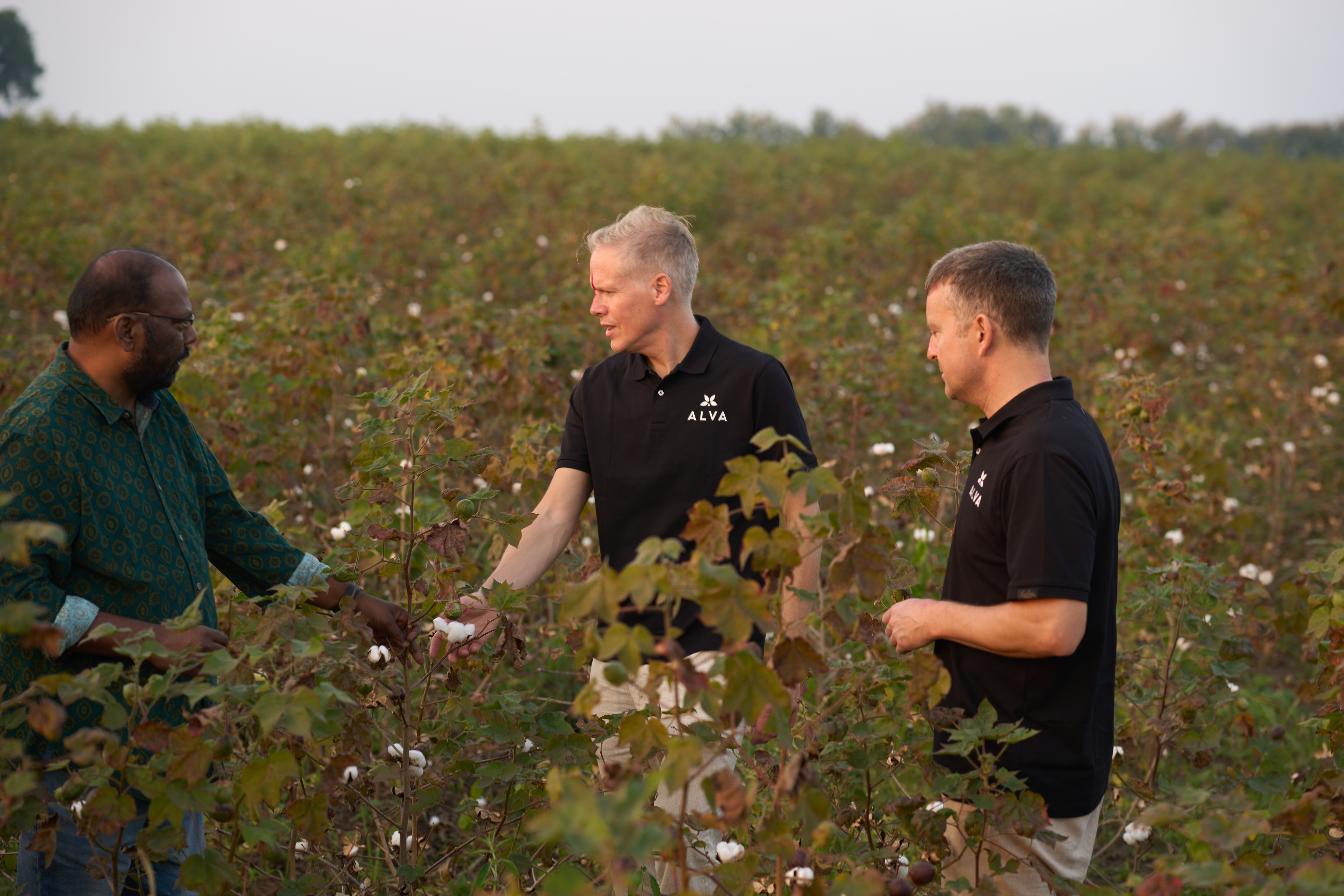
Home-textile entrepreneur Alexander Hars shares challenges when implementing regenerative organic cotton in a supply chain, and the differences it makes in the fields in India when moving from theory to practice.
Hars is CEO of Alva, a Scandinavian home-textile brand focused on premium quality and long-term responsible sourcing. He and his colleagues recently travelled through Telangana, Tamil Nadu, and Karnataka in India to follow the brand’s supply chain from cotton fields and farming communities to spinning, weaving, and sewing facilities.
– We met smallholder farmers, visited schools attended by their children, and inspected new and existing production units, he says. We also evaluated new sourcing programs, including regenerative organic cotton initiatives, and discussed future collaboration with our partners on climate resilience, water use, and social projects in local communities.
What are the biggest takeaways?
– Three things stood out:
– Climate volatility is already reshaping farming. Several farmers told us that heavy rainfall for two weeks after sowing destroyed up to 50% of crops in some regions. Extreme weather is no longer rare—it’s becoming the norm.
– Education and infrastructure matter enormously, from digital classrooms in rural schools to basic sanitation facilities that directly affect attendance and well-being.
– Regenerative practices are moving from theory to practice. We saw real momentum around soil health, crop diversity, and carbon-positive farming models.
For Alva, regenerative organic cotton was a major focus of the trip.
– Together with our partners, including Dibella India and Chetna, we reviewed farms that are already certified under Regenerative Organic Certified (ROC) standards. These programs go beyond conventional organic requirements by combining chemical-free agriculture with cover crops, multi-cropping, reduced tilling, rotational farming, and strict social safeguards, Hars shares. He continues:
– Chetna and Alva are now connected to one of the largest ROC-certified farmer groups, with more than 900 farmers already certified across regions, and cotton ready to be introduced into future orders. We are in the phase of finalising volumes and product development, and expect regenerative cotton to enter our collections in the upcoming seasons.
Can you take us through the main challenges and opportunities for you working with it?
– The challenges are to scale supply while maintaining certification integrity, higher transition costs for farmers, and longer planning horizons in product development and sourcing.
– Opportunities, on the other hand, are healthier soils and better climate resilience, carbon sequestration in farming systems, more stable livelihoods for farmers, and stronger traceability and credibility for brands.
– For us, regenerative cotton isn’t a marketing concept but a long-term sourcing strategy.

And after listening to you, I assume that you forecast that the use of it will increase in the coming years.
– Absolutely. We expect strong growth, because climate risk is forcing new farming models, brands and regulators are demanding proof of impact, soil restoration and water efficiency are becoming business-critical, and consumers increasingly understand that ‘less harm’ is no longer enough.
– Regenerative systems actively repair ecosystems, which makes them very attractive for future-proof supply chains.
What else is at the top of your sustainability agenda now?
– Beyond regenerative cotton, our current priorities include water stewardship in dyeing and finishing, renewable energy in mills, and social infrastructure in farming communities, such as schools and sanitation.
– During this trip, we also committed to funding the construction of eight toilets at a school in Tamil Nadu serving around 250 children—a small but very concrete intervention with immediate impact.

Hars now sees three major shifts across the textile and fashion industry.
– From ‘less bad’ to net positive. Brands are moving beyond harm reduction toward regenerative and restorative systems.
– Also, supply chain literacy is becoming strategic. Designers, marketers and executives now need to understand agriculture, water cycles, and carbon flows.
– Lastly, storytelling must be backed by systems. Creative work will increasingly be judged on the robustness of the underlying sourcing models, not just aesthetics. Creativity and sustainability are no longer separate disciplines—they are converging.
– What struck me most during this trip, he continues, was how interconnected everything is: climate, soil health, education, factory investments, and long-term brand strategy.
– If the industry wants resilience, we have to think in decades rather than seasons—and that means committing to farmers, ecosystems and communities in a very real way.