
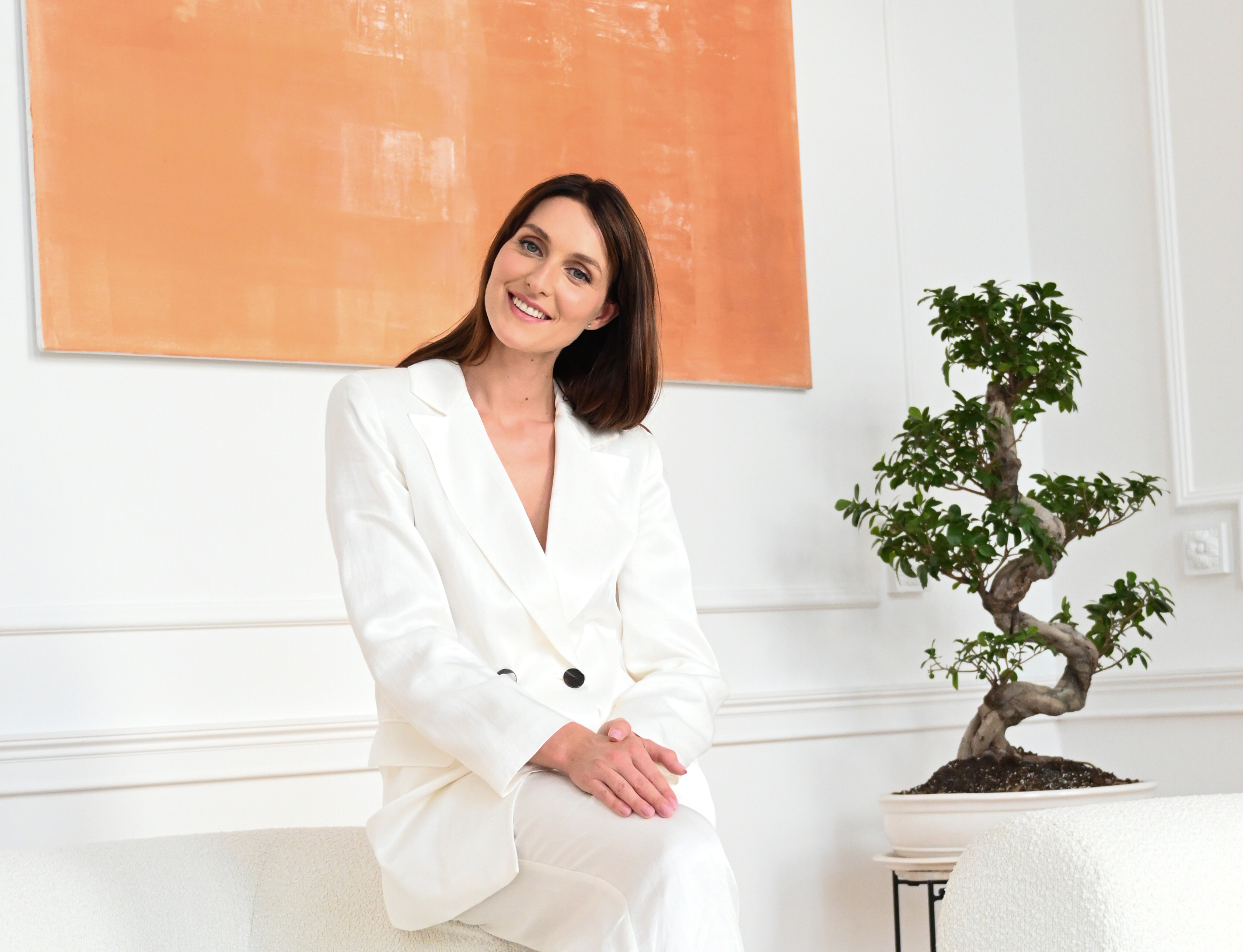
We meet the founder of hyped lip brand Monika Heiligmann Paris for an honest conversation about what works, and the things that we all have to leave—lanolin not being one of them!
As founder and CEO of the Paris- and Monaco-based company, Heligmann believes that the rise of lip care centres around the move from invasive to noninvasice cosmetic proceedures.
– Lip care has always been a big thing, but in decorative cosmetics. All the doctors that we work with say that they dissolve more fillers than they inject, and the trend that started in 2018-2019 is now over. Instead, the natural look is becoming more popular, and women are more and more afraid of side effects and migrations. That’s why they want to support their skin architecture in a natural way, she explains, continuing,
– The doctors I mentioned were previously working with invasive. Throughout their career, when seeing their patients who are following that trend, they don’t want to do anything that causes any risk to their patients. Instead, they’ve developed a movement which is reflected in skincare solutions like ours. We do bioregenerative skincare for the lips, and it’s also reflected in technology solutions like laser, microneedling, and techniques on how to treat patients.
– This, I think, is also related to longevity. People are not thinking about short-term effects. Everything that we do now is about how things impact the future of our skin health. People start thinking more globally; it’s not only about skincare but also healthy diet, healthy drinks, and supplementation, which is also brought up by more and more influencers.
– Scandinavia is really a perfect environment to discuss this; you’ve lived the lifestyle for ages that now Europe and America are trying to bring back. Also, Scandinavia, like any other region, didn’t destroy that much nature and was always following the intuition to protect natural solutions and be more conscious than other countries.
Except for this shift to non-invasive, what trends have we seen, and what do you project will happen in terms of consumer behaviour?
– Because of the economic situation, consumers are shifting their choice of products from premium brands to the lower-quality products. The market of high-end, which is the most interesting for us, is very constant all the time, and growing. On this market, there’s still not enough innovations. Now, the premium brands are losing against the mass market brands. It was an estimation that I heard two years ago, and I can absolutely see and hear it from other founders running medium price point brands.
Why is it like that, you think?
– When people have such costs related to inflation, they don’t want to reduce their quality, so they choose lower price point natural products. They can’t count on great, patented technology, which is obvious, but maybe find small or mass market natural brands with simple ingredients.
– At this point, regarding the wealthy society that looks for high-quality products, even in the economic crisis, they don’t change that much. There are new people gaining wealth in bad times, too, so the group of people buying high-end products is constantly growing. The medium group of products is the most impacted by the crisis, and the brands which don’t define themselves in other groups will be the most hurt, I think.
Heiligmann uses medical-grade lanolin from sheep in her products. The sheeps are not affected by it—it’s completely cruelty free, she states, adding that the ingredient has gotten excluded because it’s so cheap to sell Vaseline.
– Lanolin is a very good ingredient. It’s easy to speak badly about it, saying it’s allergic, and so on. We’ve never heard of anybody having an allergy to our medical-grade lanolin. It’s completely extracted from odour, colour, and allergens. The properties, how fast it can recover skin, are worth it, and the rest of the product is vegan and natural. Vegan never means natural. People are blinded by vegan and they followed this trend and one of the very big lessons I got from visiting different conferences, is that I ask people if their product is vegan or natural. People reply, ’Wait a second, vegan or natural?’ To get things vegan, we create so many synthetic solutions, and customers never care about the naturality point.
– When my team heard me saying that the market wants vegan, we were afraid to be attacked for lanolin not being vegan. But when we discussed it, my team told me not to shut it down, that we have to be the only product on the market that still contains medical lanolin and propolis. We’ll not find it anywhere in the next few years, women will never have the chance to try it, and we can’t find alternatives as good as it. We also need to have a full picture of the product to be sure that the value of one great ingredient is not destroyed by other petrochemicals that will disrupt your skin.
The lanolin is taken from Australia, which started developing it already back in the times of Helena Rubinstein, and is now leading the research in the field.
– It costs me a fortune. Vitamin C, for instance, is not produced in Europe either. Asian manufacturers have produced it at such a low price point, getting the technology from the states many years ago, which completely ruined the European manufacturing.
– This market monopoly means that when I said that I wanted Vitamin C from plants in Europe, everybody told me to forget about it; ’You have to get it from Asia.’ The best one comes from Japan, which is the most scientific Vitamin C, and costs a fortune to buy.
– When people tell me that they’ve discovered a ’miracle product’ at a very low price point, I can only say no. It’s only due to very good emollients that make it feel good. There’s no chance that there will be science, because, for using patented ingredients, we pay some 20,000 for bottles of stem cells. We use one per cent, two per cent in the different products, and we need hundreds of components to create the most scientific products.
The brand has experienced a lot of attention and growth. What makes your products stand out in the crowd?
– We are obsessed with being different from others, thinking in a different way, and not being focused on financial things. We’re seeing how many ingredients we have and want to use at least one patented ingredient per product. We put all the science that was discovered before I launched the first product into each product that represents a problem. I wanted to create a masterpiece in each category in lip regeneration, for instance, volume to make it look like lip gloss, but boosting collagen and elastin and stimulating natural processes that are responsible for the lip volume, Heiligmann explains. She continues:
– When I created masks, my idea was that when the lips are aging, women are facing lipstick migration, which comes from previous lack of use of skincare for the lips, and can make some feel unattractive. We can’t reverse it for women who never used it (skincare), but we can prevent women who don’t want it to happen. They will learn now in their 20s, 30s, or 40s that lips are ageing. Before, it was such an ignored area. When you think about what’s most important for women’s self-confidence, lips are number one. Not eyes, not breasts. That’s why so many fill them up, to feel attractive, because it’s a symbol of youth.

As a brand, you are also actively moving away from petroleum-based ingredients. Tell us more.
– These ingredients are always presented as safe. And, they are very safe. The ingredients can’t cause any allergic reaction—because they can’t cause anything…
– When people ask me what brand to choose, I tell them to take the new ones. They create new vision and, most of the time, are naive, stupid, and unprofitable with their production, so you have a chance to buy a cream that nobody would normally produce at such a high price point in manufacturing. A few years later, it’s the question if this company has survived, and if somebody acquired the company and reduced the price and quality. But, at the very beginning, when they really want to change the world, they are the best, and that’s why I only buy products like that where I can see the passion.
What have been the hardest challenge when eliminating petrochemicals and microplastics?
– It’s really difficult. You have to fight, you have to investigate, and put up a blacklist for your R&D department.
– We can’t forget that good chemists were educated already, say, 15 years ago. Their professors grew up in a petrochemical environment and were taught by people that it was fine. These will also tell you that parabens are fine. To get the best product, you cannot let your R&D department do what they want because the easiest way is always to add stuff, like silicons, and, as a brand, you will get the best feeling and the best absorption. Customers will celebrate your cream for being jelly and beautiful, and when they put their finger in the jar, it feels excellent. Even I am always thinking, ’why the hell are these creams we are trying not so soft?’ I dream of that soft feeling, but I know that not being so beautifully soft, when not using silicons, is the price you have to pay. You have to just go in a direction, explain the product, and don’t follow this texture obsession.
– With new ingredients, you can almost get a silicon feeling, from so many different plants. However, creating a product that is easy to launch takes you maybe 20 tries, but creating a product that is natural and has an amazing feeling takes you 50, 60, 70, or more. Your team is fighting, everybody is exhausted, and the laboratory that you work with doesn’t want to provide you with more samples. That’s the story I’ve had. That’s why I created my own laboratory. They (the laboratory) told me that I was the most observant customer. ’We don’t want to do your project—you have to pay for every single hour of our team.’ I said to them that, for me, it’s not understandable that in 2019, your team can’t create a 100% natural product without alcohol, silicon, and acrylate. This finished with a fight and I was happy that I was taking my research away so that they can continue doing their bad products whereas my product is the most innovative, and they didn’t see value in it.
– My team is so obsessed. When I come and ask them what the new innovations that were discovered in the last month are, they say, ’This, this, this is amazing, while this is mixed with microplastics, so we don’t even explain it to you.’ They are scanners of bad stuff. Every time somebody tells me, ’Monica, this is your competitor,’ I bring it to them and they say, ’No, absolutely not.’ I use to say that we are the smallest laboratory but the most innovative, creating the most revolutionary things. We have so many things in pipeline.
And what is the most revolutionary thing that you see now? Exosomes?
– Exosomes are amazing, and very, very exciting. We are even thinking about launching the Deep Regenerating Lip Balm in a vegan version with exosomes. We can see from clinical studies that they can have a very strong healing impact, but I still believe the most in peptides. The developer of all the peptides that are later acquired by the big brands and presented under different names is a Korean scientist. I’m in very good contact with him, meeting him at every trade show, and when I asked him about exosomes, he said to me that he still doesn’t see enough science behind.
– Peptides work to replace the process that is broken and disrupted in your skin, and stimulate it to behave like a younger version of it by activating the process that is disrupted. It’s like receiving the young version of the skin. Each peptide is multifunctional and stimulates the stem cells to produce different cells that are missing. We, for example, use growth factor technology to stimulate fat cells to gain more volume by accumulating more fat. People who don’t understand still love to use more retinol and Vitamin C because they need something to believe that it acts on, and can penetrate, the skin. It’s not that the ingredients go through the skin, but we have biotechnology that finds cell-to-cell communication in the patented ingredients from plants or peptide growth factors. It’s proven in clinical studies that by applying the cream, the cell activates a certain pathway in the cellular processes that react in a certain way. This research costs a fortune—it always costs millions to develop the patent because finding these cell-to-cell results is spectacular—and it’s what makes the product work versus a pseudo-penetration presented solution. That’s why I always say I’m not going to bed without at least one product with peptides. That is my way! Heiligmann concludes.